Sunday, June 15, 2008

Fly of the Week

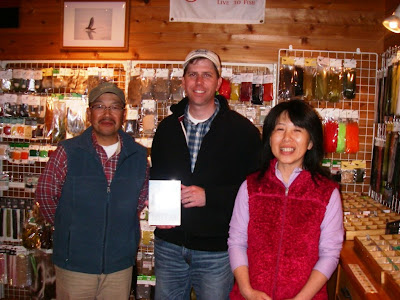
At our farewell party, Mr. Sakai san presented me with a book of 15 Traditional Flies (+1) from the fly fishing class. I have decided that I will try to learn to tie one fly each week. So far I have learned the first two flies in the book.

The first fly is the Light Cahill. I used this fly on Laurel Fork last week. It just so happened that this is the fly they were hitting on. The wings are made of mallard flank and the hackle is light ginger. Tied on a #14 Tiemco TMC 531 hook.
Here is the second fly in the book, it is the Quill Gordon. The body is made of stripped peacock quill. It uses the same mallard flank as the Cahill and the hackle is medium pale dun. Tied on a #14 Tiemco 531 hook.
Inside the book was a "Soft Hackles" sticker. Mr. Sakai san said that I was now an official member of the Soft Hackles fly fishing club. I count it a great honor.

Tuesday, June 10, 2008

Laurel Fork

I returned to Brevard, NC last Friday to try a different stream for the ellusive Native Brookie. Friday evening I fished Avery Creek and caught two small wild rainbows. The stream was very small and the water level was low.
Both rainbows were caught on a #18 Light Cayhill Mayfly.

Susanne and I spent the night in Brevard and I tried my luck again on Saturday morning. I started fishing about 6:30 am on Laurel Fork. Laurel Fork is a main tributary of the Davidson River. The conditions were much better than Avery Creek. There were many small plunge pools and pocket water. Laurel Fork is a "Catch and Release" only stream. It contains both hatchery raised fish and wild trout. Because it is a "Catch and Release" stream there is less pressure from fishermen.
I caught a nice 9" (23cm) brown. This was my first brown trout in the US.

I also caught several nice wild rainbows, the largest being about 10" (25cm).


That night we visited some friends in Highlands, NC and had a very nice meal at the Fire Side restaurant. I had pan-fried rainbow trout and spicy grits. They get the trout locally in Andrews, NC.
I still was not able to catch a Wild Native Brook Trout (brookie). My fly fishing mentor Dr. Kawano is very eager for me to catch a Native Brookie. I have been researching native brookie streams in North Carolina. Here are a few of the things I have learned so far.
1. Brookies require pristine, clear, cold mountain streams. Pressure from acid rain and silt from improper development have led to a decline in brookie habitat.
2. Brookies do not compete well with the non-native trout species (rainbows, browns and northern brook trout) that have been stocked in the mountain streams of the Appalachians over the past century.
3. As a result of habitat destruction and competition from non-native species, the native brookies can only be found in the most remote high elevation streams in the Appalachian Mountains of North Carolina.
4. Native Brookies will likely be found in streams at elevations above 4000 ft that are cut-off from lower streams by a natural barrier (such as a waterfall) that prevents the non-native fish from traveling upstream.
I discovered a research paper from Western Carolina University where DNA testing was performed on wild brookies in Jackson County. It found many streams where the brookies had interbread with non-native northern brookies that were introduced through stocking. It also found several streams that still have pure Native Appalachian Brookies. I will not publish the names of these streams here, but if you promise to catch and release I might email them to you.
I can't wait to try to catch some of these little jewels.

Tuesday, June 3, 2008

Looking Glass Creek

I finally managed to go fly fishing for the first time sense returning from Japan. I would have gone sooner but I had to have outpatient surgery that I had been putting off.
Susanne and I went to the Davidson River in the Pisgah National Forest located in the Blue Ridge Mountains of North Carolina. About a 2 hour drive from Greenville.

The main part of the Davidson River is hatchery supported, but heavily fished making the fish very spooky. I decided to fish one of the streams feeding the Davidson called Looking Glass Creek. It is a small spring creek with constant water temperatures between 50-55 F (10-13 C). Because of the cold water conditions, it can be fished all summer long (with no closed season).
Looking Glass Falls is a 60 ft (20 meter) waterfall which provides a natural barrier that prevents the hatchery fish from going upstream. This means that the area I fished above the falls is a "wild"area.

(Susanne at Looking Glass Falls)
The “wild” areas are mostly inhabited by native Brook trout (brookie), wild rainbows and browns.
We arrived at the stream side around 2:30 pm. I tied on a #18 cripple mayfly (a fly given to me by Kurematsu-san while I was in Japan). The stream was only 2 to 3 meters wide and the water level was low because of a recent dry spell. There was also a lot of mountain laurel and rododendron overhanging the stream, making casting difficult. Short side casts were the best way to fish most areas. My first cast produced an 8” (20 cm) wild rainbow, the largest of the day as it would turnout. It was fun catching the fish right in front of Susanne. After a few pictures I walked about 15 ft upstream and caught another one. I new it was going to be a good afternoon!
I managed to catch 7 raindows in an hour and a half. They were small fish but it was big fun!


On the return home we stopped at the Ranger Station and spoke with the park rangers. They gave me some good information on other places to fish in the future.
I really would like to catch some of the wild native brook trout that live in the remote higher elevation streams. I will definitely be returning to this area soon.

Wednesday, April 30, 2008

Toyamagawa

April 27 I went to Toyamagawa River in the Southern Japan Alps for my final fly fishing trip in Japan (for a while anyway). My assignment in Japan has come to and end so my wife and I will be returning to the US on May 1st.
It was about a 4 hour drive from Kakegawa to Toyamagawa in Nagano Prefecture. Below is a view from an overlook on the way.
I went with 4 other friends from Slow Life. I spent the day fishing with "Funkey Monkey" Okie-san (below). He caught a nice 19 cm amago using the traditional Japanese fly fishing style, Tenkara.
Satoh-san also tried his hand at Tenkara. He is using a bamboo Tenkara rod given to him by the chief editor of "Fly Fisher" magazine, Oguchi-san.

I only caught one fish for the day, a pretty decent 23 cm amago.


Tuesday, April 15, 2008

Oshino

After leaving Ashinoko on Sunday morning we went to Oshino River, about a one hour drive. We stopped by the "River's Edge" fly fishing shop and talked to the local pro, Watanabe-san and his wife. He told us the best place to fish on the Oshino River.

We went to Section 8 (Kindaichi) of Oshino River. If you click on the link below, it will take you to an interactive map of Section 8. Click the camera icon to view photographs along the river. If you select the 2nd camera from the right, that is where I was fishing. http://www.ffmedia.net/oshino/oshino_guide_map.htm

Kawano-sensei was fishing just upstream from me. He caught a nice brown trout, but I did not get a picture, sorry. Standing behind Dr. Kawano is Take-san. He served as my guide for the entire afternoon. He was very patient and helpful. He "loaned" me several flies which I promptly lost in the trees.
Take-san gave me a personalized keychain (pictured below). It has a beautiful engraving of a Japanese Yamame trout on one side and my name on the other.
(below: 20 cm brown trout I caught using a #16 CDC mayfly)

(below: 29 cm brown trout I caught using a CDC mayfly)

(below is a nice 35 cm rainbow. I caught it on a #16 mayfly and 7X tippet)
Daisuke-san and Ru-chan having some quality father-son time as mommy and Take-san look on.

Mr. Sakai-san caught two rainbows at Oshino (22 cm and 30 cm).

After fishing we returned to the River's Edge fly shop for dinner, they have a small cafe there. I had a delicious roastbeef sandwich.

Monday, April 14, 2008

Ashinoko

Saturday: Mr. Sakai-san and I met some of our fishing friends at Lake Ashinoko for some Rainbow fishing. Lake Ashinoko is located in the crater of the extinct Hakone volcano. It is 725 meters above sea level, very clean and pristine. It reminded me a lot of Lake Jocassee in South Carolina.
(below: stock photo of Lake Ashinoko with Mt. Fuji in the distance)

We rented a motor boat for the day. It was only 9,000 yen (about $90) for the day, including a tank of gas. This was the first time I have ever fly fished from a boat. It was really nice not worrying about my back-cast getting hung in the trees.

(Here is Niida-san taking us to a good spot on the other side of the lake.)


We fished using Olive Marabou Damselfly's on #12 hook. Niida-san caught the first two (or 3?)rainbows. Then Sakai-san caught 2 rainbows. Average fish size was about 30 cm.
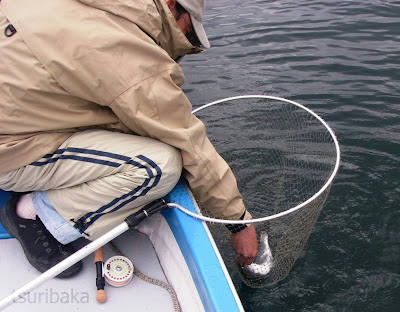
(below: Sakai-san landing a 31 cm rainbow)
(close-up)

Sunday morning while we were packing up we ran into Taka Sugisaka-san in the parking lot. Sugisaka-san is a very famous fly fisherman in Japan and around the world. I had just purchased the May issue of Flyfisher magazine which has a 4 page article written by Sugisaka-san. He was gracious enough to sign the article and let me have my picture taken with him.

(the autographed article)

Next stop is Oshino Spring Creek...

Tuesday, April 8, 2008

Ketagawa Weekend

My fishing friends and I spent Saturday and Sunday fishing the Ketagawa River, a branch of the Tenryu River North of Hamamatsu. The weather was perfect! Saturday I fished with Dr. Kawano, my good friend and fishing sensei (teacher). I had a few rises but no fish-on.
A very large Amago rose to Dr. Kawano's fly at the area pictured below, but he did not take it. We both tried many casts in this area but he would not rise again.The next day on Sunday, Mr. Sakai-san joined Dr. Kawano and I. Mr. Sakai caught the first fish, a very nice 20cm Amago. He took the fish in a deep clear pool. This is a difficult situation, because the Amago can easily see you approaching and head for cover. This area is heavily fished which makes the fish even more difficult to catch.
As we continued up river we came to the bend where the large Amago rose to Dr. Kawano's fly on the previous day. We watched the water for a few minutes and immediately saw the fish rising to natural flies. Dr. Kawano made several casts but had no luck. We decided to stop here and eat our lunch as we continued to watch the fish rising. Dr. Kawano said the water had undermined a large rock at the back of the bend and that the trout was hiding under the rock.
After lunch, Dr. Kawano told me to give it a try. I was a little reluctant at first because I new I only had a 7X tippet (2.3 lb test) on my leader. I decide to tie on a #12 black parachute mayfly with peacock herl body (a gift from Shimizu-san last weekend). I crawled to within casting distance and made about 6 casts to where the Amago had been rising. I was about to give up but decided to make a couple more tries. Finally, he took the fly and made a mad dash downstream. I was in a panic, because I did not want to break him off. Luckily there were no rocks downstream for him to dive under in which case I surely would have lost him. The first photo below shows me landing the Amago, what a relief!

He measured 25.5 cm. This is by far the largest Amago trout I have caught in Japan.
I appreciate the patience and coaching from all my friends from the Lifestyle Design College.
Tuesday, April 1, 2008

Sasamagawa Revenge

Last weekend I spent two whole days fishing the Sasamagawa River.

Saturday (3-29-08):
Clear skies and light wind. I did a little better than the previous weekend. I caught two Amago trout. They were both small, one was 15 cm and the other 16 cm.Of course Mr. Sakai-san caught the largest fish, a nice 22 cm Amago (below)
Sunday (3-30-08):
AM overcast skies turning to rain around noon. Unfortunately Mr. Sakai-san was not able to join us this day. But I did have the pleasure of fishing with Oguchi Shuhei-sama, founder and chief editor for Tsuribito-sha, the parent company for Fly Fisher Magazine. Mr. Oguchi-sama is 85 years young and it was quite an honor to meet him.
We had a large group Sunday. We had a nice lunch on the river bank complete with hot coffee. (left to right) Kiwi Yoko, Doko Ji, Oguchi-san, Shimizu-san, Satoh and Karematsu.
Mr. Shimizu-san caught a 15 cm Amago. He is a tenkara fisherman, the traditional Japanese form of fly fishing. It uses only a long rod with the line attached to the tip (no reel). The flies resemble mayflies emerging from the water (emergers). Mr. Shimizu-san would whip the fly down into the water about 1-2 inches deep, let it drift down stream, then pull it straight back out imitating the action of an emerger. Very interesting to watch. (below- Mr Shimizu tenkara fishing).
After a long cold rainy day of fishing we all went to a small onsen (hot springs) in the mountains nearby named Kurami Ochiaiso. We had a nice soak and a dinner party afterward. (below- I am wearing an antique Tenkara fishing hat (sugegasa) donated by Shimizu-san and Oguchi-san to the Lifestyle Design College.)

By the way, the folks at DK Littleton Outfitters in Greenville South Carolina posted one of our photos from Kanogawa on their website. (follow link below)

http://www.dklittleton.com/bragging.asp